Featured Story: Election

Friday, May 04, 2007

Delhi

From India Picture...

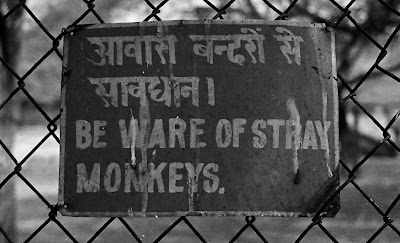
I was holding onto my seat white-knuckled as we drove from New Delhi airport, dodging the cows wandering along the road, weaving around the huge trucks sharing space with cars, scooters, auto-rickshaws, bicycles, and people just walking alongside the traffic. This is the vivid memory I have of arriving in India for the first time 3 and a half years ago. I remember the sign hand-painted on the back of every truck: Horn Please. "Horn please?" I thought, as the sound of beeping came at me from all sides. "Surely they're not asking people to make more noise."

And I recall realising, upon seeing all types of vehicles heading up roads the wrong way, that in India there are no rules, only guidelines. This idea was reinforced every time Naveen, the driver-turned-friend from my father's work, entertained my mother and me by saying, "In India, anything is possible!" before doing a U-turn into oncoming heavy traffic, or taking a shortcut down an impossibly narrow street packed with people, animals, and cycle-rickshaws.

I also remember talking to people who had visited India in the '80s, commenting to them that it must have been such a different place back then. I was initially surprised when I heard the response, "No, not really." But as I got to know the excruciating beaurocracy underpinning so many facets of the country, I began to understand.

Our driver Sukhdev, for example, is involved in a lawsuit against a previous employer who didn't pay him for his last 3 months of work. The lawsuit was first brought 18 years ago. 3 plaintiffs in the same suit have died in the interim. It is still ongoing. This is the pace of things here.

So you can imagine how fascinating it's been to notice differences on each return visit. India is starting to change. There is now a highway leading from New Delhi airport. Gone are the pedestrians and non-motorised vehicles. Gone is the traffic heading the wrong way. It's smooth sailing, at least by Indian road standards.

Large areas of Delhi are now cow-free, the result of an effort that began a couple years ago to clear the streets of bovine roadblocks. The humorous scenario involved the government placing a bounty on each cow. Freelancing cow-shepherds then drove around spotting wandering groups of the animals, bundled them into the backs of trucks, drove across the river Yamuna and outside the city limits, and then dumped their loads. Sort of what I imagine the mafia do to witnesses after intimidating them.

Many of these steps are undoubtedly required to enable India to progress, but they do take away some of its charm. I left the flat one sunny day a few years ago and walked downstairs to the car to find an elephant there, tearing off tree branches for a morning snack. Although I may have hid it because this was my home and I wanted to act like a local, my excitement was no less than the first time an elephant ambled by the flat, owner in tow. Naveen was present on that first occasion, looking on as I scrambled to get my camera to capture the event.

"This is amazing!" I was thinking at the time. "An elephant! On the street! Walking by my house! An elephant!"

Just as amazing was watching Naveen when my mother commented to him that where we come from, elephants don't wander the streets.

"Really, ma'am?" he said with a look of wonder. "Don't you have elephants in your country?"

Who knows what changes are in store for India? The idea of elephants on the streets of Delhi may seem just as hilarious to Naveen's grandchildren as the idea of elephants strolling around DC seems to me.

Wednesday, May 02, 2007

The Cuba Blog


It looks like the Anonymous Cuba Blogger has put up a final closing post. I wanted to mention the blog again for those that missed it the first time I linked to it — it's been updated periodically since then and is an interesting read for those curious about Cuba.

Tuesday, May 01, 2007

Himalayas

From Sikkim / Darj...

A few days ago I got back from an 8-day trek in the Himalayas. It involved a lot of steep climbs, fog, and freezing weather. In other words, not unlike a summer in San Francisco. What was unlike San Francisco was the style of hiking. When I was living there last year I took a trip to Yosemite National Park with Anne. Between the two of us, we carried two hiking packs with clothing, sleeping bags, tent, and supplies. This is not the way things are done in India. I was with my parents and Marlene, a friend of ours. To sustain the four of us, there was a guide, a cook, 3 ponies, a pony-carer, 4 yaks, a yak-carer, and 3 porters. I could die of altitude sickness, but I wasn't going to die of loneliness.

Speaking of altitude sickness, the hike was tempting fate a little bit — my previous two bouts with high altitudes ended with me accepting bitter defeat (one with a dramatic K.O.). But this time, in ascending from 1,700m to roughly 4,500m, we did things in proper fashion and took two rest days to acclimatise on the way up. These seemed to do the trick as I had no major problems.

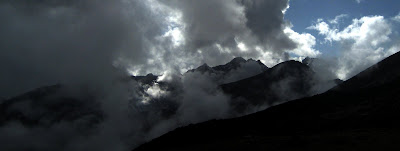
We had two 4am rises to hike to lookouts by dawn, but the pain and shortness of breath from the thin air was worth it. The scenery was spectacular. We had views of Kanchenjunga, 3rd highest peak in the world after Everest and K2, as well as neighbouring peaks and glaciers at the base of the mountains.

On the last evening, the four of us stood at the small Tibetan village of Tsokha looking out. In front of us, we could see for miles down the valley, and to the side, up to sharp peaks. We watched as an immense cloud engulfed the valley below us, then slowly moved upwards. Standing above the cloud in the clear air, we could see the edge of it approach us bit by bit, until finally we were wrapped in a cold white mist so thick that trees 10 meters away disappeared.

This may have been the last big hike on my trip. If so, it was a fine way to end things. I was a little worried on the drive to the starting point when we passed an overturned car on the windy mountain road, blood-spattered windshield lying nearby. It seemed an ill omen to begin with. It's lucky I'm not superstitious or it might not have turned out so well.

Monday, April 09, 2007

Risk Factor

Every place has its stories of muggings and murdered hitchhikers. The difficulty when traveling is in separating hype from reality in any given place. After talking with some fellow travelers, I decided to test my feeling that China was relatively safe. I left a 1 yuan banknote conspicuously sticking out of my back pocket to see how long it would take to disappear. I walked around a market at night, the center of another town by day, and after a couple days it was still there. It stayed until a waitress pointed out I had money hanging out of my back pocket, and I should be careful because there are pickpockets everywhere. I tried to explain to her the irony of the situation but something got lost in translation. I put the yuan back in my wallet, amused in the way my theory of China being safe had been proven.

A couple nights later I bumped into what can only be called a true American character. The type of person who used the phrase "world famous in America" when describing a brand of knife he was partial to. In his 50s, he had been living in China for over 5 years and owned a restaurant which he ran with his Chinese wife. ("I used to be married to two redheads — I'm a Mormon, see — but now I go crazy for these cute little Chinese!") Just how much he did compared to his wife became less clear when he kindly offered french fries and then sent his wife to the kitchen to make them.

His experience with thieves in China proved more dangerous than mine. Of the 5 attempts pickpockets had made on him, 4 ended in spectacular failures for the would-be takers of his things. One guy had the pleasure of being upturned into the fishtank of a neighbouring restaurant, with his head held underwater until he gave up the knife he had taken. ("I'll be damned if they take my knife from me.") A second fellow had his arm broken after trying to snatch the bag he thought had been left momentarily unattended. ("I was watching him from the corner of my eye, but I waited until he grabbed the bag to be absolutely sure he was a thief before I taught him a lesson.") And when a group of thieves encircled the one-man army in Beijing and told him to get out his wallet, he surprised them by taking out the small bottle of gasoline he kept in his pocket and spraying it in their faces. ("Don't need to light it on fire — the fumes asphyxiate their lungs. Taught us that in 'Nam.")

So maybe it's possible China is dangerous and my carefree experiment proved I'm a victim of youthful ignorance. The only piece of advice I'm sure of is this: if you go to China and see a vigilante-looking type in a black cowboy hat, don't try taking his money.

Maonia

It's funny that Chairman Dictator Mao is on all the banknotes in China. Germany didn't put Hitler on the Deutschmark, and Chile doesn't plaster Pinochet on its peso. I wonder at what point China will be forced to take an honest look at its past.

It's also interesting that plenty of tourists seem to buy Mao's little red book. If that's a hip piece of pop culture, imagine how cool it will be when I open a store in the States that sells figurines in white hoods holding burning crosses.

Blog Dump

I've been in India a week, and now that I can kick back at my parent's house I've been slack with the blog. I meant to post these next few before leaving China, but things slipped.


Perhaps to demonstrate their opposition to oppression, the Chinese population uses its freedom to smoke to the fullest. Education on the effects of cigarettes doesn't seem very widespread, although the day after my 26-hour journey a train-load of people came close to finding out just how deadly smoking can be.

It was a day I was looking forward to as I only had to face a 3 hour ride before arriving at my destinatino of Yangshuo where I could relax. Unfortunately, things began to go wrong right at the start of the day.

I hoisted myself up from the train station platform to the carriage and the first thing that struck me was how full the train was. There were so many people the door wouldn't open all the way, and with my hiking pack I wasn't going to fit through the narrow opening. The second thing that struck me was someone from behind, putting his full weight against my pack and miraculously mashing me into the crowd.

After some physics-defying shifting, I had standing space. Not what I was hoping for, but I could deal for 3 hours. Then I found out that I wasn't on a 3 hour train ride after all. I had 16 hours to take in the experience. At this point, it seemed worth the effort to find the seat I had booked. After slowly making my way down the carriage — a painstaking process involving one passenger shifting a foot here, another moving an elbow there, then carefully taking a step while avoiding treading on a leg or head — I found my seat occupied by a couple people. I took a few inches of the corner and alternately sat and stood over the course of the ride. The crowd around me was very friendly, which helped pass the time.

When I took out my pen and paper to write, heads crowded in from all round to see the foreigner making strange characters with his left hand.1 And the entire carriage hushed to listen (and then laugh) when I tried to learn a few basic sentences in Chinese. I later found out most of the people were rural farmers and their families — they had finished their work in the fields and were headed to the cities to earn money for 6 months until the harvest. This explained not only the crowds, but the greater than usual interest in me.

The real excitement started around midnight, the time when those stuck standing leant against a seat and closed their eyes, and those scrunched on the floor put their heads on their knees to catch some sleep. That was when a group of farmers huddled together, passing around a large bong while keeping a watchful eye for passing train inspectors. I don't know what they were smoking. It wasn't marijuana but it didn't look like tobacco either.

It was amusing to watch the looks on their faces, like teenagers doing something they knew could land them in trouble, but they weren't helping the hazy air. Despite the presence of wailing infants, people had been smoking in the enclosed space all day without any windows or doors to open.

At some point, the farmers had their fill and the bong went into hiding. That show was replaced by a man unsteadily making his way up the aisle, a uniformed inspector in tow. When he reached where I was standing, he seemed to decide he had had enough walking and stopped, looking unsure of himself. The inspector started giving him short, sharp prods, telling him to move. I looked at Mr. Had-A-Few-Too-Many, thinking, "If the inspector doesn't stop provoking him, he's going to blow his lid."

Sure enough, a second later the man started throwing drunken punches, arms flailing. Soon a second inspector arrived, and dodging fists aimed for his face, got the man under control. The two inspectors led him away down the carriage, and I sat down on my corner of seat, a little more awake for the front row spectacle.

Not half a minute had passed when I heard shouts behind me. I turned around to see a woman grasping weakly at the air before slumping into her seat. People crowded around trying to revive her, but nothing worked. A minute passed and she was still lifeless. After another minute an inspector made his way into the carriage. He wasn't having any luck either, but he did manage to clear some space around her. At this point her eyes were open and staring blankly. She looked dead. The inspector unlocked the window and fresh air came pouring in. But still nothing. Finally someone decided to take her somewhere less crowded. As he hoisted the woman on his back I heard her groan faintly. They disappeared into another train car, and presumably she recovered. Apparently all the smoke and lack of fresh air had been too much for her body.

The people in the carriage seemed to recover fairly quickly from this shock, and realising there was now an open window, began emptying the space of a day's worth of trash. First went a big plastic bag full of it. Then empty instant noodles buckets. Then a trash can packed to the brim. Then I stopped looking. The train arrived an hour late and I got off, thankful I didn't have to endure the 42 hour journey to Nanjing that many others were in for. By 4am I was checked into a hostel dorm, struggling to sleep over the roar of snoring emanating from an adjacent bed.


  1. I learnt almost all Chinese write right-handed due to how characters are formed with brush strokes.↩


Monday, April 02, 2007

Missed Adventures in Cuisine

I've had enough of illnesses and disasters on this trip, so I've been a little more cautious in the things I've chosen to eat while in China. In more adventerous days I might have tried "strange flavour meat from lamb's head," but not anymore. Other choice menu items I have restrained myself from eating include "fragrant and hot crap" and "old mother in relative shredded beef."