Featured Story: Election

Tuesday, June 12, 2007

Home?

From Tel Aviv / Je...

What is home? This is a question that's been on my mind for several years. Whenever I'm feeling down and lonely while on the move, it's where I want to go. Then where is it? During my travels I've found the feeling of home whenever I return to a place more familiar than the last I was at. I may only have spent a few days there before leaving, but upon returning, whether I know a couple people or just a couple streets and restaurants, it's more comforting than a totally alien place. But surely you can only truly call one place home.

Is mine in Washington DC where I grew up? None of my family are there now, so if home is a place you can go back to, that doesn't work. Maybe it's in England, where my parents grew up, the land whose culture therefore infiltrated my upbringing and made me not wholly American. But I wasn't raised there, and my British friends wouldn't consider me a Brit. India? I've spent more time there than in either of my two "home" countries in the past 4 or 5 years. But to call myself Indian would be absurd on so many levels.

What makes up the idea of home? Is it pop culture, religion, where your friends are, where your family is from, the community you grew up in? The answer of course is no single one of these options but a combination. It's also something else, as I'm starting to find out here in Israel. It's where your ancestors lived 3,000 years ago. It's a culture you share not through common experience but through your heritage. It's being labeled as part of a group not because you choose to be part of it, but because others decide you are.

My grandfather was an atheist. That didn't stop Nazis in Germany barring him from university one semester before completing his degree to become a doctor. According to them, he was Jewish. I'm an atheist too, but should a similar situation arise in the future, I could do nothing to stop other people calling me Jewish due to the lineage passed down through my mother, and therefore I share something in common with Jews all over the world. Although this connection to something I did not previously feel a part of is a strange concept to me, I can understand it. However, I have as much trouble understanding other ideas as a fish does the Theory of Relativity.

I asked an Israeli friend why Israel had to be created where it is. Why not another, less tense part of the world? His was not religious reasoning, that God gave the land to the Jews; he is an atheist. His grandparents, originally from Czechoslovakia, had never felt at home in that country. He didn't feel at home anywhere but Israel. This was the land the Jews were exiled from almost 2,000 years ago. It is home to them. It's the only place that makes sense. This was his response. It's one I struggle to understand.

Where does this sense of home he was talking about come from? I tried searching for an equivalent example I could relate to. 3 of my 4 grandparents were from Germany. Do I feel a special draw to the country? Two years ago I visited the house one of my grandmothers grew up in in Berlin. It was a nice place which I surely wouldn't mind having as my own, but I felt no right to that piece of land she was forced to leave. With that kind of disconnect in the passage of just two generations, I cannot comprehend the connection some people draw between themselves and their ancestors thousands of years in the past.

The concept of a Jewish homeland is one that also perplexes me. When I visited Jerusalem last week, I went to the Yad Vashem, a museum about the Holocaust. It's a fantastic and devastating place. When confronted with the reality of what happened to Jews during World War II, it's easy to justify the creation of a place where Jewish people could be safe from persecution by others.

But in the end this is a racist solution, plain and simple. It brings up the question, is "good" racism possible? In an ideal world we wouldn't need it, but we live in a non-ideal world and maybe it's an appropriate non-ideal solution.

I found out I'm entitled to an Israeli passport because I'm Jewish, and went to a centre which provides help with immigration. The woman there told me what's involved in the process of becoming a citizen, or making Aliyah as it's called. The law requires people in my age bracket to serve 100 days in the military. The upshot is that the government is keen to attract Jews and provides benefits: 16,000 shekels (~US$3,800), lower income tax, free Hebrew lessons, free medical insurance for half a year.

The key to unlocking all this wealth and good fortune is proving that I'm Jewish. In explaining this, the woman at the centre explained the racist nature of the state itself.

"Israel is the only country in the world where the majority of the population is Jewish. Most people, including myself, want to keep it that way. So we have to do everything we can to encourage Jews to immigrate and discourage others. That's the game you play. If you don't like it, too bad."

I asked if it's possible to immigrate to Israel if you're not Jewish. She looked around and said in a low voice, "no," as if it were a dirty secret.

But what does this mean for me? I'm Jewish because someone somewhere at some moment in time might point in a rulebook and say so. This cannot be enough reason to call Israel my home. I share no more culture or religious beliefs with any given Israeli than I do with many other people on Earth. And I feel no loyalty to the Israeli state. Given this, the underlying question I find most bothersome is why am I entitled to be a part of Israel when others aren't?

On the level of an individual, the way this state is designed to perpetuate a Jewish majority seems no more fair to me than any other system which gives certain people rights and denies others the same ones based on meaningless groupings.1

I am far from having a definite opinion on all this, but in the meantime, trying to understand other people's idea of what home means has brought me no closer to my own understanding. If anyone wants to clear it up for me, I'm all ears.


  1. I realise I'm ignoring the question of other countries' automatic citizenship policies. Perhaps each could be considered as arbitrary as the next?

Thursday, June 07, 2007

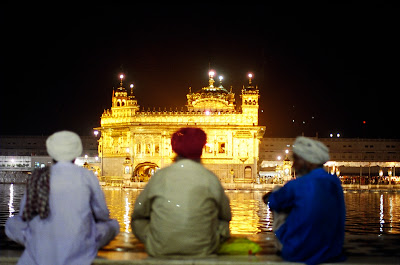
The Golden Temple


Like the previous India post, this one dates to a short while ago when I was still in that country. It's taken me a while to finally write it down.

A visit to the Taj Mahal is an example of what-you-see-is-what-you-get. There is only a small degree of separation between looking at a picture of it and visiting it in real life. What I found at the Golden Temple in Amritsar, the holiest of places in the Sikh religion, was much more than a building.

I arrived in Amritsar, close to the Pakistani border in northwest India, early in the morning following an overnight train ride. Stepping inside the gurdwara (temple complex), there was an endless parade of people walking barefoot clockwise around a man-made lake, at the center of which sat the Golden Temple. I joined the crowd and before long found myself talking to a Sikh around my age. Normally I would be on edge, expecting some kind of trickery designed to end in the transfer of money from my wallet to his, but he was so genuinely friendly that I was instantly at ease. We sat on the cool marble in the shade and talked, and later, over chai in a stall outside the temple, he played me hit Punjabi and Hindi music from his phone, occasionally singing along with a heavy Indian accent.

That night I returned to the temple with Crystal, who I had met at the accommodation next door. Beds are provided free to any and all pilgrims — even to foreigners and non-Sikhs like us. Several hundred people were sleeping in the many rooms there, and also on the ground in the courtyard and the balconies surrounding it.

We went to the langar — a dining hall dishing out food to any and all who come, 24 hours a day, again, free of charge. It's an amazing operation that serves roughly 30,000 meals daily and runs on donations and the work of volunteers who prepare the food, serve, and wash the dishes.

At 1 am we entered the gurdwara once more to find some people sleeping around the perimeter of the pool and others standing on the causeway to the temple in the center. We joined the line to the central temple where during the day, the Guru Granth Sahib (holy book of the Sikhs) is kept. Each night it is ceremoniously carried out of the central temple and put to bed. We climbed several flights of stairs and came out on the open roof. There we sat with the stars above and the constant sound of singing and tabla-playing from the priests several floors below coming over the speakers. In front of and around us, people sat with prayer books following the words to the music. With each hour that passed — 2am, 3am, 4am — the temple complex filled with more and more people. By the time we left at 5am it was more crowded than when I had visited at 10 in the morning. As we walked out of the central temple and back along the causeway, I could feel the heat from the mass of people waiting in line to enter.

What I took away from my visit was far more than the image of the beautiful gurdwara. There was a very real feeling of welcoming around the temple, and a peacefulness too. (This despite the fact that there had been rioting nearby in the two days I was there, which I only found out subsequently.) I could have easily passed many more hours sitting, watching, and listening.

Inbox Count: 0

This post is more for my own records than anyone else's general interest. I have zero unread emails in my inbox. This type of momentous occasion (i.e. not being lazy and replying to emails on time) happens only once or twice a year. I'll enjoy the feeling of cleanliness for the next 2 hours while it remains. Then I'll be inundated again. Probably with spam.

In other news, Eero left on Monday and I'm back to travelling solo. We fell short of our goal to eat 80 falafels in 2 weeks. We reached 60, but once we got to Tel Aviv there was such a wide variety of delicious food to choose from that we caved to temptation and got distracted.

Tuesday, June 05, 2007

A Delhi Night

A quick note: this dates from several weeks ago before leaving India. It's taken me a while to snap out of the unproductive funk I was in there and write about it.

The evening began with an explosion. The last time it happened, my mother ducked and looked around wild-eyed, thinking a bomb had gone off. This time I knew it was the downstairs neighbours setting off fireworks. These weren't little firecrackers that shot some sparks in the air, they were full-on July 4th-caliber rockets. They let out an ear-splitting bang as they launched their payloads on skyward journeys; several seconds later the sky lit up with globes of lights and sparkles tumbling back down.

These fireworks are readily available for purchase in India at around US$8 apiece, and being somewhat of a firework fanatic, our neighbour had bought a crateload to celebrate his brother's visit to Delhi. He let off the smaller ones early on — a smart decision as apparently the launch platform had yet to be perfected. One mistakenly went off at an angle, shot into the street and under a car that happened to be passing by. I feared an explosion Hollywood style, sparks shooting everywhere as the vehicle was lifted high in the air, but luckily it let out a harmless flash and a bang while the car drove on.

As the show continued I started noticing other flashes against the dark sky, and soon a strong wind blew in with a few drops of rain. As dust flew everywhere the brothers packed up and headed indoors to wait out the oncoming storm. I went across the street to the Mother Dairy stand to buy some ice cream and as I waited for my change, the sky opened and rain poured as I've never seen before. The streetlights illuminated branches being thrashed by the wind and rain being blown in sheets. When two towers of stacked plastic crates came tumbling down onto a parked car, I thought it best to wait in the shelter of the concrete overhang of the Mother Dairy rather than risk having a tree limb land on me as I crossed the street. I stood and watched what looked like the backdrop of a live news bulletin — the type where the reporter is on site in a hurricane, clutching his raincoat against the weather onslaught.

At some point the wind subsided enough for me to venture out from under the overhang. I made a dash across the street to the house, getting drenched in a few short seconds. There was so much water washing down the road that my feet and ankles got a dirty bath in the process.

After showering and changing, I started opening the windows to let the now-cool air into my room. As I leaned out of one to fasten it open I heard a man coughing. It sounded far too close to have come from the street 3 storeys below. I looked around and in the dark, made out the shape of a monkey sitting on the balcony railing. Slightly surprised, I made sure to close the screen to avoid any surprise attacks while sleeping.

Tragically Forgotten


I've heard "Can't Touch This" and "Ice Ice Baby" more and more over the past few years. The question is, if MC Hammer and Vanilla Ice are retro-cool, why not Milli Vanilli? In an effort to fix this injustice I've dug up a piece of their golden musical past.

One look at this video and I think you'll agree Milli Vanilli deserve to be remembered. There's Oscar-worthy acting to set the scene at the beginning. Some Michael Jackson-rivaling dance moves (the running stomp is a piece of choreographed genius). And even MC Hammer's parachute pants have a tough time beating the fashion sense of huge shoulder pads. You know it's true.

Friday, June 01, 2007

Tel Aviv

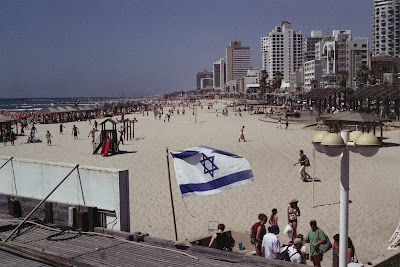
I believe in love at first sight. It happened to me 3 days ago. After taking a long distance bus up from southern Israel, Eero and I took a local bus through Tel Aviv and I fell in love with the city. It's hard to describe the reasons why, but here are a few: relaxed atmosphere, small enough to walk around, big enough to offer a variety of neighbourhoods, lots of cafes and stores on the street, large parks, green areas, beaches easily reached by foot from the centre of the city, sunny and breezy, fantastic food.

Speaking of food, I went to an annual festival where the city's top restaurants sell samples of their dishes for around US$5 apiece. It's a great deal for restaurants and eaters alike, as people get to try many places they wouldn't otherwise.

I know what you're thinking: "I've been to a food fair before." Not like this. Picture an outdoor music festival, take out the bands but leave everything else: lights, stages, DJs playing music, food stalls encircling a huge area of grass, and above all, people. Huge crowds of people eating, drinking, talking, dancing, and sometimes even crowdsurfing. I couldn't believe that the entire celebration was centred around the enjoyment of food: Jerusalem tortillas, African-spiced sausages and potatoes, east-west fusion beef in coconut sauce, coffee cream cake, cheesecake, I could go on. I'll have some pictures from the event when Eero sends them to me after getting home next week.

I've been trying to find a fault with Tel Aviv, something that will make it easier to leave, but so far I've come up empty-handed. The good news for me is that I don't need to leave yet. I originally planned to travel up through Syria to Turkey, but ran into a 3-strikes-and-you're-out scenario. I tried and failed twice to get a Syrian visa. My last resort plan was to take a flight to Damascus and hope for more luck with the passport control officers at the airport. That dream officially died when I walked across the Jordanian-Israeli border and got a stamp in my passport. When crossing into Syria, if there is any evidence of travel in Israel you are automatically barred from entering. I had asked immigration not to stamp my passport, but the woman behind the counter accidentally put one in anyway. When she realised what she had done, she was embarrassed and apologised, but there was no way of erasing the ink from the page.

The end result is that instead of going back to Jordan and then heading north, I'll stay in Tel Aviv a little longer. Maybe after another week the rush of new love will have worn away.

Out of Jordan

My last dive in Jordan was at night. There were three of us — Eero, me, and our instructor Abdullah — plus one soldier watching to make sure that all the people who entered the water came out again. We dove the same site earlier in the day, but at night it was transformed. Gone were the schools of fish swimming by, shimmering in the light blue water. In their place were lone creatures making their way through the blackness. As we shone our flashlights around we come across a tiny octopus, a strange box-shaped fish, and a large crayfish which Abdullah managed to catch and stuff in his pocket for later.

Because the dive was going so smoothly, Abdullah took us to a nearby shipwreck. The king of Jordan had sunk it specifically to create a site for divers. We had visited it previously during the day and it was spooky then. At night it was positively eery.

We had been swimming along the sea bed for a while when all of a sudden our lights illuminated a wall, the ship's hull, rising up above us. The ship was resting on its side so when we rounded the front, the deck rose up from the ground at a steep angle. 15 metres down in the black water, I couldn't see anything but the captain's cabin above me oriented almost vertically, and Eero and Abdullah floating nearby. Pointing my light away from the boat — up, down, behind me — the beam disappeared into darkness. It was the first time I felt dizzy and disoriented underwater. I had to remind myself of the way the ship was resting to figure out which way was up and which was down.

We swam along its length, the deck a wall on our right. Structures slowly took shape as we approached in the darkness. I pointed my light up and saw the ship's mast looming horizontally above our heads. I pointed it to the right and saw an open hatch with a ladder leading into the gloomy interior. Everything was rusty, with coral growing over it and the odd fish hiding in corners and recesses. As fascinating as it was, it definitely tested my nerves. The constant fear in the back of my mind was imagining what it would be like to get left behind in the darkness with the hulking skeleton of the ship for company.

I was relieved when we at last swam over the side and headed away from it, encountering the sandy ocean floor again. Before getting out of the water we sat with our flashlights held to our chests to block out the light. When we moved our hands through the water, tiny specks of phosphorescent plankton lit up.

The next morning we left Jordan. It fulfilled my expectations in the best way possible: by tearing down a lot of preconceptions about life in the middle east. Namely, that the entire area is a dangerous place and that people are at war with the west. I remember the man running the hostel I stayed at in Amman saying that if you visit a mosque during prayer time, you'll only find 5 or 6 people there. Who has time to pray 5 times a day? He may have been joking, but the point was clear. People are people, no different from the US where some are Catholic and some are Methodist and some are Jewish and on and on. In Jordan, some are Christian and some are Muslim and some are devout and some don't care much. And everyone mixes together, with Ms. Jeans chatting away to Mrs. Fully-Veiled. Not all that surprising, really, though it does conflict with the image we sometimes get from the news where the middle east is a uniform mass of people headed on a collision course with the US and EU.

Overall, I was won over by the genuine friendliness Eero and I encountered everywhere. So many people were keen to simply say hello and welcome us. Try and think of the last place the following happened to you: a policeman stops you in the street and asks where you're from. Maybe you're intimidated by his gun and wonder what problem he is about to create for you. Then he asks you if you've been here before. Upon finding it's your first time, he shakes your hand and says "welcome to our country," before walking off with a smile. If you're coming up blank on memories of this happening in your life, I used to have something in common with you before I visited Jordan.